
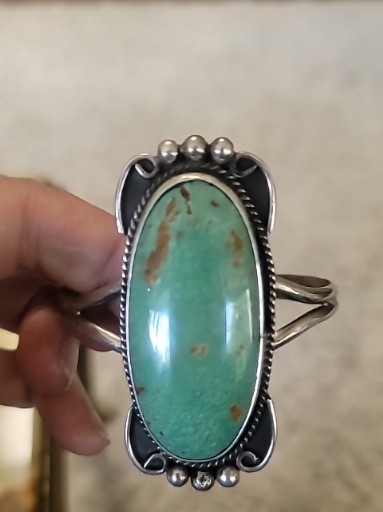
Sterling silver cuff bracelet with turquoise stone, Southwestern Native American style

History
This style of sterling silver and turquoise jewelry emerged from the Southwestern United States, particularly among Navajo and other Native American artisans, with significant production during the early-to-mid 20th century. The Harvey Era (1900s-1940s) saw increased production of Native American jewelry for the tourist trade along the Santa Fe Railway, making these pieces widely available to collectors. Such bracelets feature hand-stamped designs, rope-twist bezels, and silver bead accents that became hallmarks of Southwestern silverwork. Turquoise jewelry from this period remains highly sought after by collectors of Native American art, Western Americana enthusiasts, and vintage jewelry lovers. These pieces are valued for their craftsmanship, historical significance, and the natural beauty of American turquoise, which varies in color from blue to green depending on the mine of origin. The combination of sterling silver and genuine turquoise creates timeless wearable art that connects modern collectors to the rich cultural heritage of the American Southwest.
Origin
Southwestern United States
Time period
circa 1930-1950