
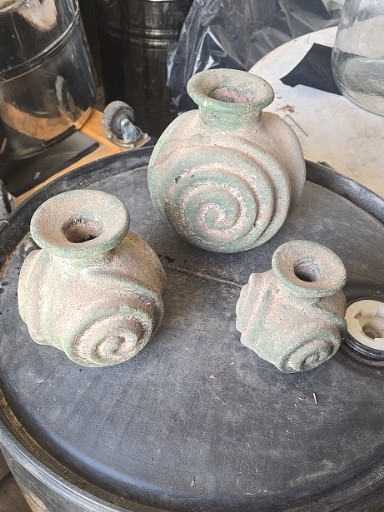
Set of three ancient caliche pottery vessels with spiral relief decoration
History
These vessels are crafted from caliche, a naturally occurring sedimentary calcium carbonate material found in arid and semi-arid regions, particularly in the American Southwest and parts of Mexico. The use of caliche for pottery is extremely rare and ancient, predating traditional clay ceramics in some desert cultures. The spiral motif is a sacred symbol found in many ancient Southwestern and Mesoamerican cultures, representing water, life cycles, and spiritual journeys. The weathered, mineralized surface and primitive hand-building techniques suggest these pieces could be several centuries to potentially over a thousand years old, depending on their specific origin and archaeological context. These artifacts hold significant appeal for collectors of Pre-Columbian art, ancient Southwestern pottery, and archaeological specimens. The extreme rarity of caliche as a pottery material, combined with the age and cultural significance of the spiral designs, makes these vessels highly valuable to museums, serious collectors of indigenous American art, and scholars of ancient pottery techniques. Such pieces are prized for their historical importance, the insight they provide into ancient crafting methods, and their connection to the spiritual and daily life of early desert-dwelling peoples.
Origin
Southwestern United States or Northern Mexico
Maker
Indigenous artisan, specific culture undetermined
Time period
Pre-Columbian era, possibly 500–1500 CE