
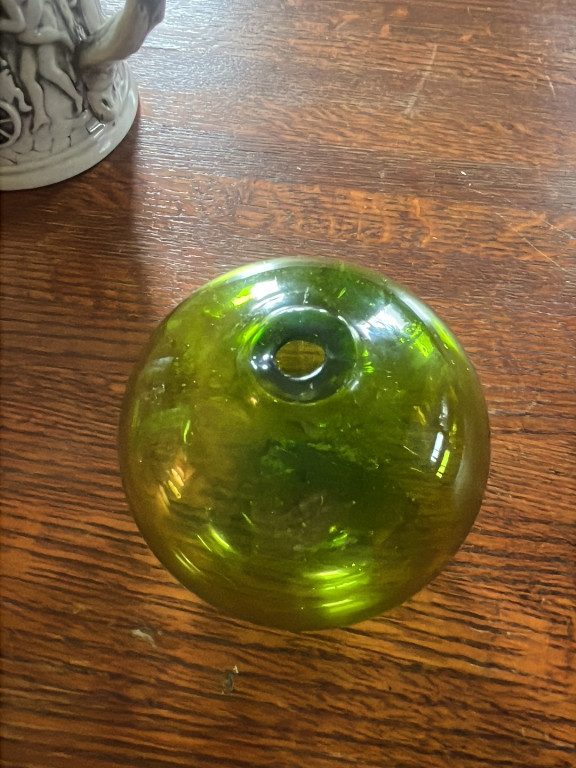
Green glass Japanese fishing float
History
Japanese glass fishing floats, known as 'uki-dama' or buoys, were handblown from the late 19th century through the mid-20th century to support fishing nets in the Pacific Ocean. Produced primarily in coastal regions of Japan, these hollow glass spheres were sealed with a distinctive pontil mark and came in various sizes and shades of green, blue, and amber. Production declined in the 1960s as plastic floats replaced glass. These floats have become highly sought-after collectibles among maritime enthusiasts, beachcombers, and vintage glass collectors. Their appeal lies in their handcrafted nature, historical significance to traditional Japanese fishing practices, beautiful translucent colors, and the romantic notion of objects that drifted across vast ocean distances. Collectors prize them for their craftsmanship, the variations in color and bubble patterns within the glass, and their connection to maritime history.
Origin
Japan
Time period
Late 19th to Mid 20th century