
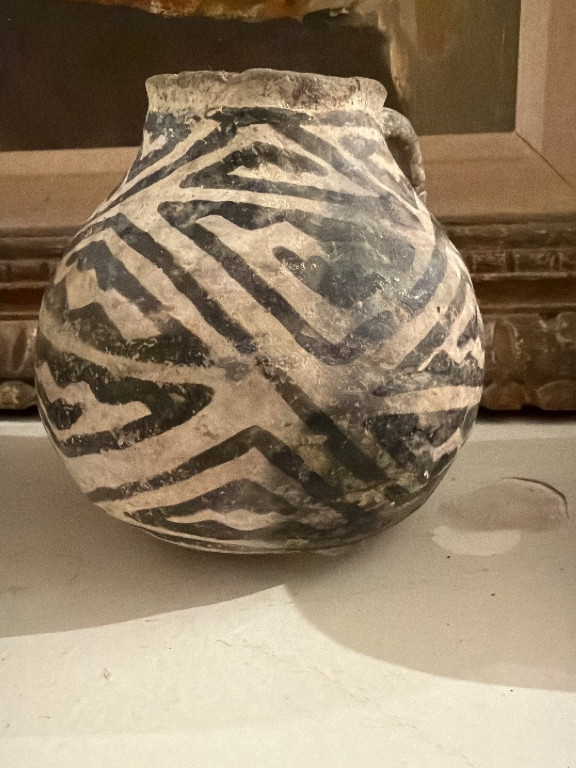
Ceramic pottery jar with geometric black-on-white decoration, Ancestral Puebloan (Anasazi) culture

History
This pottery jar represents the sophisticated ceramic tradition of the Ancestral Puebloan people, commonly known as Anasazi, who inhabited the Four Corners region of the American Southwest from approximately 1100 to 1300 CE. The distinctive black-on-white geometric patterns are characteristic of the Mesa Verde or Chaco Canyon pottery styles, created using mineral-based pigments painted on a white slip before firing. These vessels served both utilitarian and ceremonial purposes in daily Puebloan life. This particular piece comes from the 1950s collection of the late Dr. Ernest Jean Long, purchased at Marian Davison Antiques on Shattuck Avenue in Berkeley, California, adding documented provenance that enhances its historical value. Ancestral Puebloan pottery is highly valued by collectors of Native American artifacts, archaeologists, and museums for its artistic merit and cultural significance. The geometric designs reflect the mathematical precision and aesthetic sensibilities of these ancient cultures, making each piece a tangible connection to pre-Columbian North American civilization. Such artifacts are treasured by serious collectors of Southwestern antiquities and institutions dedicated to preserving Indigenous American heritage. The documented mid-century provenance from a respected Berkeley antiques dealer adds authenticity and collectibility to this piece.
Origin
Four Corners Region, Southwestern United States
Maker
Ancestral Puebloan (Anasazi) artisan
Time period
circa 1100–1300 CE