
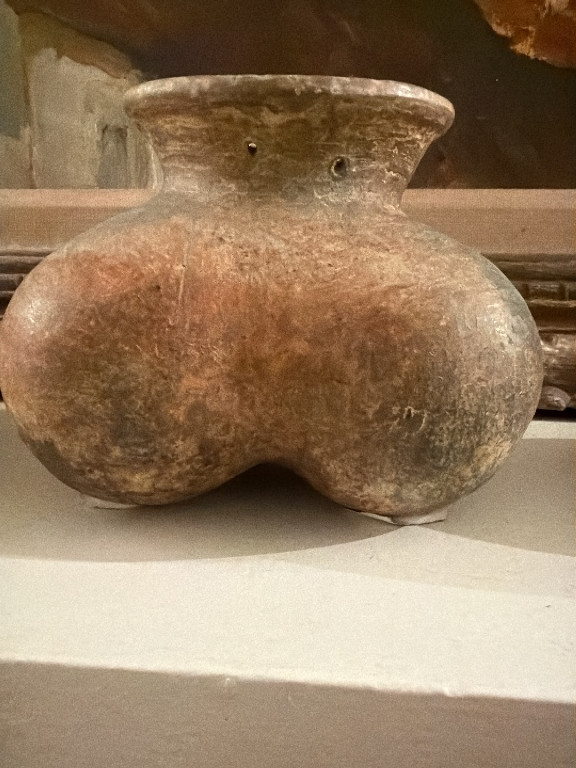
Pre-Columbian earthenware tripod vessel from Colima culture, West Mexico

History
This tripod vessel originates from the ancient Colima culture of West Mexico, flourishing between 300 BCE and 300 CE during the Late Formative to Classic periods. The distinctive bulbous lobed feet and rounded body are characteristic of Colima pottery, which was primarily created for funerary purposes and placed in shaft tombs. The small holes near the rim likely served a ritual or practical function, possibly for suspension or as part of ceremonial use. The burnished surface and organic forms reflect the sophisticated ceramic traditions of West Mexican cultures. Pre-Columbian Colima pottery is highly prized by collectors of ancient American art, archaeological artifacts, and Mesoamerican antiquities. Museums, private collectors, and institutions specializing in pre-Columbian art actively seek authentic examples of Colima ceramics. These vessels represent an important window into the spiritual beliefs and artistic achievements of ancient West Mexican societies, making them valuable both as historical documents and as works of art. The provenance from the 1950s collection of Dr. Ernest Jean Long, acquired through the respected Marian Davidson Antiques of Berkeley, California, adds significant historical collecting interest and enhances both authenticity and market value.
Origin
Colima, West Mexico
Maker
Colima culture
Time period
circa 300 BCE–300 CE