
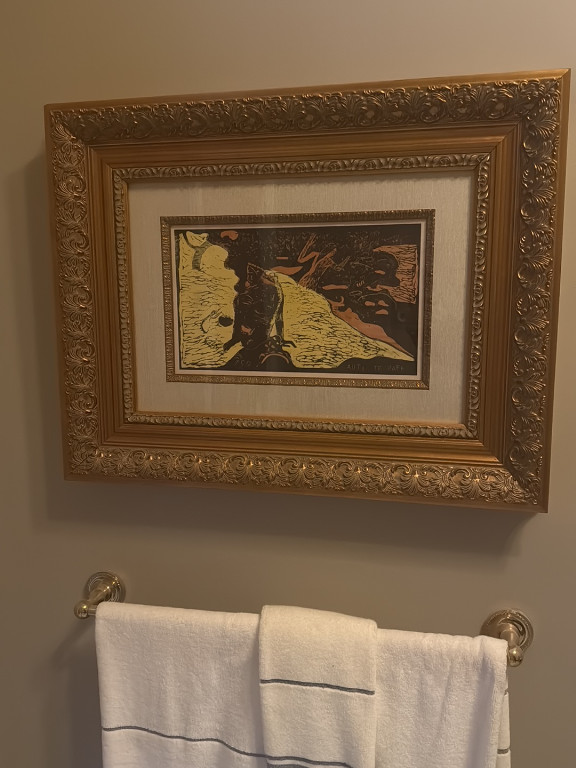
Woodcut print titled 'Women at the River (Auti te Pape)' after Paul Gauguin

History
This print reproduces Paul Gauguin's 1894 woodcut 'Auti te Pape' (Women at the River), created during his first Tahitian period as part of the Noa Noa suite. The original woodcuts were revolutionary for their bold, primitive style and use of color, reflecting Gauguin's fascination with Polynesian culture and his rejection of European artistic conventions. The Noa Noa series documented his experiences in Tahiti and became some of his most celebrated graphic works. Gauguin prints appeal to collectors of Post-Impressionist art, Polynesian cultural artifacts, and fine art prints. These works are valued for their historical significance in the development of modern printmaking and their exotic subject matter that captured Western imagination about the South Pacific. Museums and private collectors prize authentic period impressions, while later reproductions remain popular as affordable decorative art representing a pivotal moment in art history.
Origin
France
Maker
After Paul Gauguin
Time period
Late 20th to early 21st century reproduction