
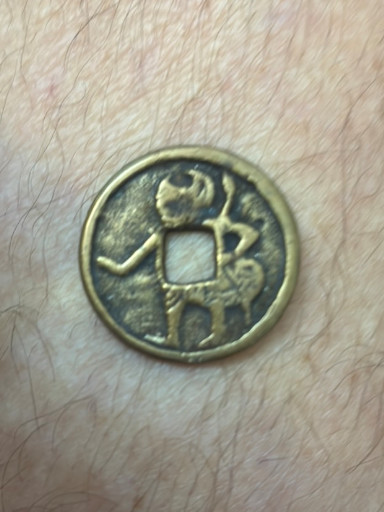
Chinese entertaining cash coin 'Hongwu Tongbao' depicting shepherd boy riding ox

History
This is a Chinese entertaining cash coin, also known as a charm or amulet coin, from the late Qing Dynasty to early Republic period (late 19th to early 20th century). Unlike standard currency, these coins were created for ceremonial, decorative, or good luck purposes. The design features a shepherd boy riding an ox, a popular motif in Chinese culture symbolizing pastoral tranquility and harmony with nature. These entertaining coins appeal strongly to collectors of Chinese numismatics, Asian cultural artifacts, and those interested in folk art and traditional symbolism. The shepherd boy and ox motif represents themes of innocence, simplicity, and the Daoist ideal of returning to nature, making these pieces valued for both their artistic merit and cultural significance. Such coins are sought after by specialized collectors of Chinese charms and amulets who appreciate their historical context and symbolic meanings.
Origin
China
Time period
Late Qing Dynasty to early Republic period (circa 1880–1920)